- Home
- Our services
- Wasps and flying insects
- Ground wasp nest
Ground wasp nest removal
Montreal, Laval and the South Shore
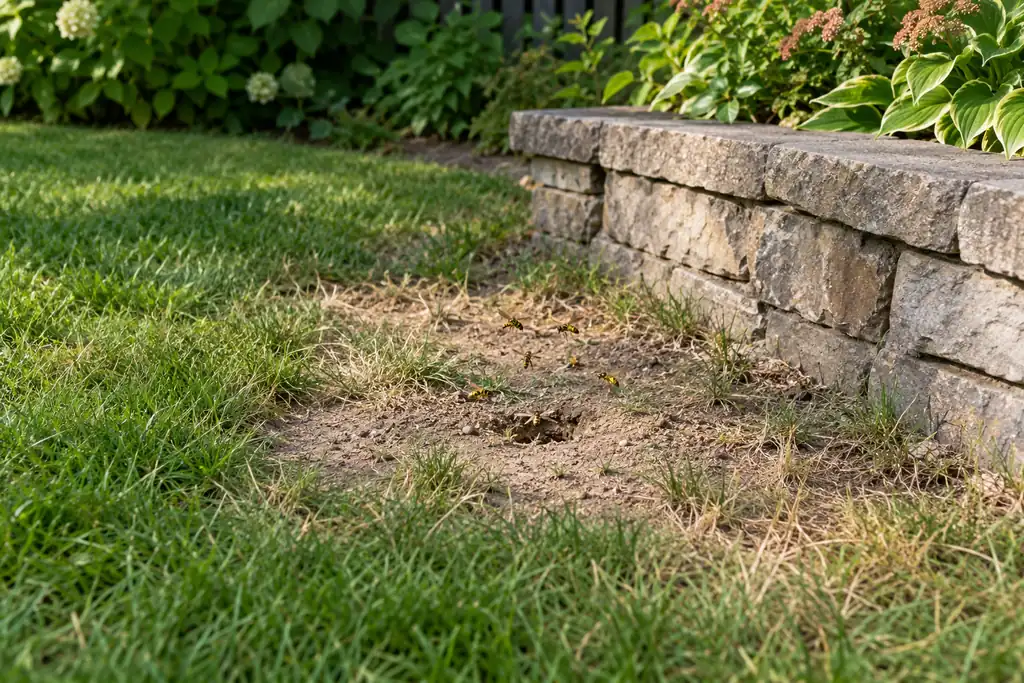
A hole in the lawn, between the rocks of a garden bed or at the edge of a slab, with wasps flying in and out nonstop: that's probably a yellowjacket colony living underground. The danger is running the mower over it or letting kids play right beside it. Keep everyone away and leave the entrance alone.
In Quebec, yellowjackets generally nest in the ground. In spring, the queen moves into a cavity that already exists, an old rodent burrow for example. The workers then enlarge it, digging and carrying out soil and small pebbles. By late summer the colony is at its peak: more wasps, more activity, and an entrance that's easy to miss in the grass.
An underground nest catches people off guard because nobody sees it coming. One pass of the mower or string trimmer, a ball rolling over the hole, a dog sniffing around, and the wasps pour out to defend the colony. Unlike honeybees, each wasp can sting more than once. This falls under our wasp nest removal service. When the wasps vanish into your siding instead, the page you need is wasp nest in a wall or soffit.
Yellowjackets, bumblebees or solitary wasps?
Yellowjackets
Smooth body striped yellow and black, fast flight. One hole, a steady stream of workers and a quick reaction if you get close: this is the nest that causes trouble.
Bumblebees
Big and fuzzy, they're bees. They also nest underground, often in an old rodent hole or a gap in a low stone wall, and won't sting unless their nest is disturbed.
Solitary wasps
Each female digs her own small burrow, often in sand or bare soil, like digger wasps. Most wasps in Quebec are solitary: they don't defend their nest the way social wasps do and are rarely a danger.
Not sure?
Don't walk up to check. Call us at 514-231-1615 and describe what you see from a distance: the size and colour of the insects and the number of holes.
How to spot a nest in the ground
Watch from a distance, standing up, without leaning over the hole.
- Wasps diving into the grass and coming back out at exactly the same spot
- A small hole at ground level, sometimes ringed with a little soil or tiny pebbles carried out of the nest
- Wasps slipping under the edge of a patio slab, a step or a sidewalk
- Wasps coming out of a gap between the stones of a rock garden or low wall
- Wasps bursting out of the ground when the mower or trimmer goes by
- Kids getting stung on the feet or ankles in one particular spot of the yard
Where ground nests turn up
Residential
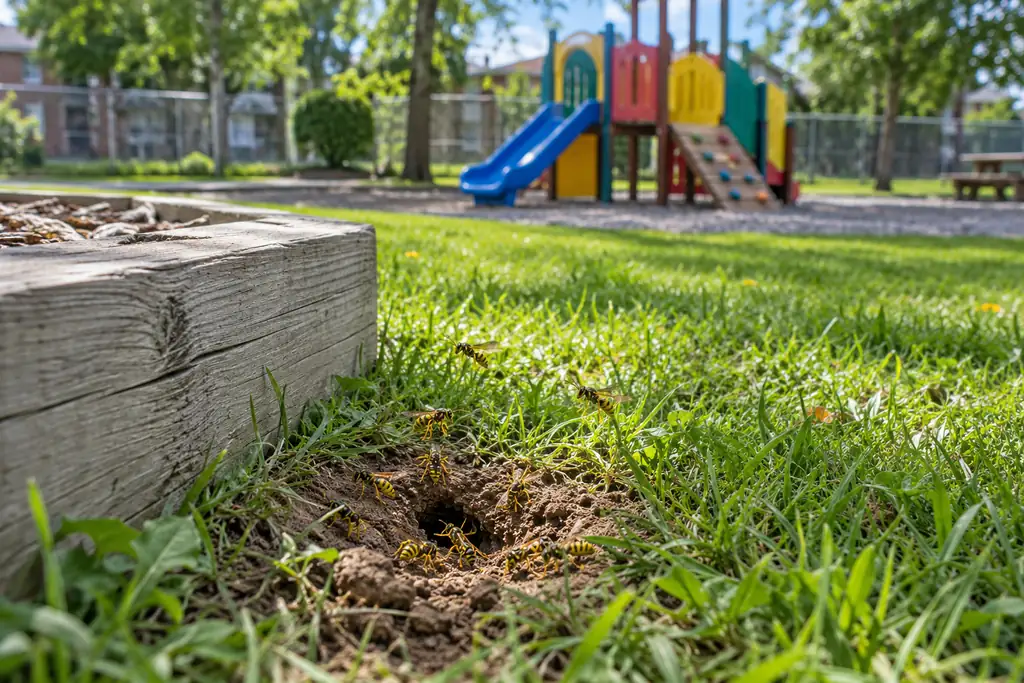
- Lawns and patches of thin grass
- Rock gardens, low walls and flower beds
- Edges of slabs, patios and sidewalks
- Under steps and low porches
- Sandboxes and play areas
Commercial and industrial
- Daycare and school yards
- Apartment building lawns
- Flower beds in front of stores
- Warehouse grounds and slopes
- Edges of parking lots
- Restaurant patios on concrete slabs
How we deal with a ground nest
Nobody needs to go near the entrance before we do.
Confirming
First we confirm the insect: a yellowjacket nest isn't handled like a bumblebee nest or solitary wasp burrows. Then we locate the active entrance and any other holes.
Securing the area
We'll ask you to keep children and pets inside during the treatment and to keep the mower away from the area.
Targeted treatment
Late in the day, when most of the workers are underground, the technician treats the colony directly with a registered product, protected against stings.
Follow-up
We tell you what to avoid afterwards and when you can mow that area again. If wasps are still using the same hole, give us a call.
Making your yard less inviting next summer
- Early in spring, before queens start looking for a nest site, fill old rodent burrows and abandoned holes with well-packed soil: those are the cavities they look for.
- Fill the gaps under sinking slabs and steps, and reset loose stones in low walls.
- From midsummer on, take a look from a distance at the risky spots before each mowing: slab edges, rock gardens, thin grass.
- Cover pet food and leftovers outside, and keep garbage cans and the compost bin closed: workers come looking for protein and sugar.
- In late summer, mow in closed shoes and avoid walking barefoot on the lawn.
- Don't count on a preventive exterior treatment to keep wasps away: it targets ants, spiders and crawling insects, and a ground nest is treated separately.
Frequently asked questions
Can't find what you're looking for? A technician answers 24/7.
Call 514-231-1615Can I drown a ground wasp nest with the garden hose?
We advise against it. To flood the entrance you have to stand right next to it while the colony reacts, and an underground nest is hard to reach to begin with. Never pour gasoline or any flammable liquid into the hole: besides contaminating the soil, it can cause an explosion or serious burns.
I ran over a wasp nest with the lawn mower. What should I do?
Get away quickly and leave the mower where it is. Bring children and pets inside. If someone has been stung many times or is having a severe reaction, call 911.
Why not just cover the hole with a rock?
Yellowjackets dig: blocking the entrance doesn't kill the colony, which may come out a little further along, and you have to lean right over the nest to do it. Montreal's Insectarium also points out that plugging a nest entrance yourself is always risky.
What does ground wasp nest removal cost?
That depends on how many nests there are, where they are (lawn, under a slab, rock garden), access and the risk to people nearby. The quote, given after we look at the situation, is free.