

- Home
- Our services
- Wasps and flying insects
- Wasp nest in a wall
Wasp nest in a wall or soffit
Montreal, Laval and the South Shore
When wasps keep slipping into the same gap in your siding, soffit or roof, their nest is hidden inside the structure. Whatever you do, don't seal that opening: cut off from its exit, the colony can end up inside the house. We deal with the nest first and close the gap after.
A wasp doesn't need much of an opening. A siding joint that's pulled apart, a poorly fitted fascia board, a torn soffit vent or a gap around an exhaust vent is enough to reach the hollow space behind. Some species look for exactly these dark spots: wall cavities, attics, the underside of a porch. Sheltered from the weather, the nest grows all summer out of sight, and a colony can number in the thousands.
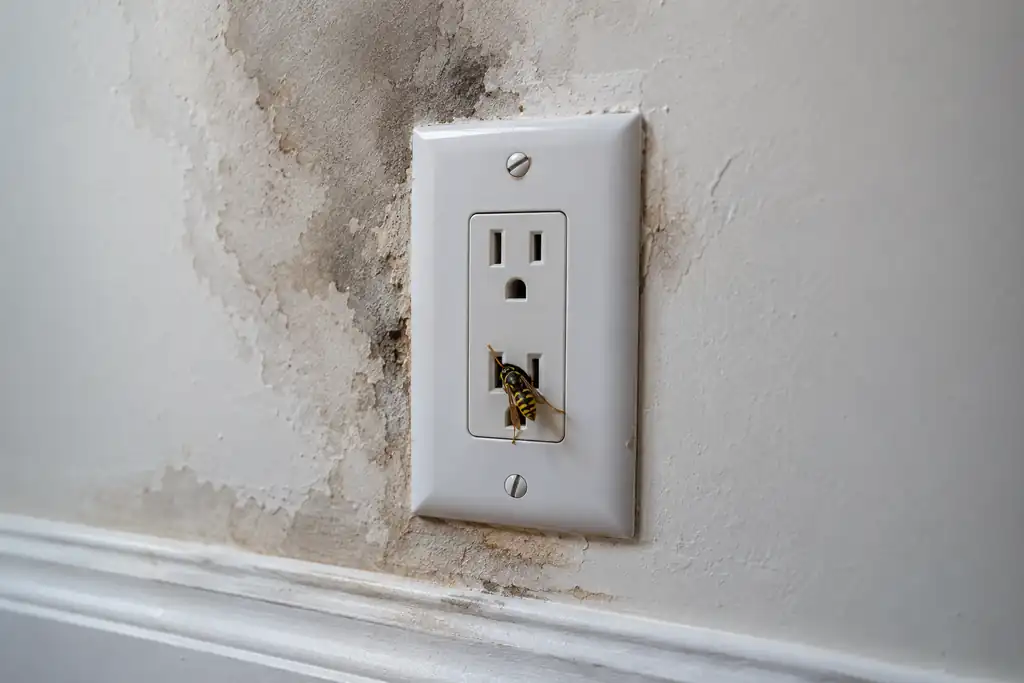
Reaching for caulking or spray foam is the riskiest move. A hidden nest usually has a single entrance. Block it and the wasps may chew a new passage or follow the electrical wiring indoors, showing up near a light fixture or an outlet. If what you see is a grey paper ball hanging under the eaves, that's a different job, covered on our hornet nest page. This page is about the nests you can't see, part of our wasp nest and flying insect service.
How wasps get into your walls
Siding
A vinyl joint that's opened up, a split wood board, a crumbling mortar joint. The entry point can be at eye level, near a window or a corner.
Soffits and fascia
A torn soffit vent or a loose fascia board opens a path into the attic. The nest may sit right in the roof overhang or further in, above the ceiling.
The roof
A lifted shingle, loose flashing around a chimney or roof vent, the joint between two roof slopes. Wasps that disappear there are nesting under the roof deck or in the attic.
Exhaust vents
Dryer, range hood, bathroom fan. A flap that no longer closes or a gap around the duct lets wasps reach the wall cavity.
Where these hidden nests turn up

Residential
- Vinyl, wood or brick-clad walls
- Soffits and fascia on houses and plexes
- Attics
- Under porches and balconies
- Sheds and garages
Commercial and industrial
- Storefront cornices and parapets
- Plexes and apartment buildings
- Daycares and schools
- Metal-clad warehouses
- Restaurant and office façades
Signs of a nest hidden in the structure
The nest stays out of sight; the wasps are what give it away.
- Wasps landing on the siding or under the soffit, slipping into a gap and coming back out a few seconds later
- Buzzing or scratching behind a wall, a ceiling or up in the attic, always in the same spot
- Wasps in a closed room, near a light fixture, an outlet or the attic hatch
- Wasps circling a dryer, range hood or bathroom fan vent even when the appliance is off
- Traffic at the same point of the siding that keeps building week after week
How we handle a nest inside a wall
Every step has one goal: the wasps never find their way indoors.
Finding the entrance
We watch the traffic to find the active opening and locate the nest: wall cavity, roof overhang or attic. We also check inside, around light fixtures and hatches.
Treating the colony
We treat the colony once the wasps are back inside, wearing protective gear and using registered products suited to a hidden nest. The entrance stays open during this step.
Checking
We make sure activity has stopped at the entrance and that no wasps are moving around the house. A nest we can reach is removed; one left inside the wall is dead and won't be reused.
Closing the gap
Only once the nest is inactive is the opening closed: caulking, a new soffit vent or, if needed, siding repairs. For materials and the spots to close up, see sealing entry points.
After the treatment: seal it without trapping them
- Wait until the nest is inactive before caulking, adding a vent cover or repairing the siding. Closing up too early risks pushing the wasps indoors.
- Replace torn soffit vents and refasten loose fascia before spring, the season when queens look for a sheltered spot to start a nest.
- On a dryer vent, make sure the flap closes properly, but never add a screen: lint builds up behind it, blocks the exhaust and creates a fire hazard.
- In spring, a single wasp that keeps slipping in and out of the same siding joint or roof corner is often a queen starting her nest: at that stage it's far easier to deal with than a full colony in August.
- Keep the attic hatch closed and well fitted: if a colony settles up there, it's harder for the wasps to reach the bedrooms.
 Service 24/7, free quote
Frequently asked questions
Can't find what you're looking for? A technician answers 24/7.
Call 514-231-1615When can I seal the hole a wasp nest is using?
Once the colony has been eliminated, or late in the fall for a nest that isn't bothering anyone, when the colony has died off. Sealing earlier, while wasps are still coming and going, is what risks sending them inside. Use caulking for a siding joint and a metal vent cover for a soffit.
Why are there wasps in my house when the windows are closed?
They may be coming from a nest in a wall, a ceiling or the attic, through a gap around a wire, a recessed light or a hatch. Close the door to that room, keep children and pets elsewhere and don't block anything. Call us: we'll find the outside entrance and treat the colony.
Will the wasp nest in my wall come back next year?
Not the same nest: in our climate only the young queens survive the winter, usually somewhere else, and the old nest isn't reused. But an opening left unsealed can attract a new queen in the spring. That's why we close the gap once the nest is inactive.
What's the price for removing a wasp nest inside a wall?
The price depends on how high the entrance is, whether the wall or attic is easy to get at, the type of building and how far along the season is. We look at the situation first; the quote costs nothing.
