

- Home
- Our services
- Wildlife
- Groundhog
Groundhog removal
Burrows under sheds and porches
A big hole at the base of the shed, the dirt thrown up in a heap, lettuce eaten down to the ground, a patio slab starting to tilt: a groundhog has dug its burrow on your property. We find every entrance to the burrow, trap the groundhog in a cage sized for it, then seal each entrance.
Groundhogs are plant-eaters that live in burrows dug into well-drained soil. Around homes, they tend to settle under a shed, a low porch or along a foundation, where the soil is loose and the entrance is sheltered. A burrow has two to five entrances linked to chambers by a network of tunnels, and the animal doesn't stray far from it as long as there's food close by, like your vegetable garden.
Groundhogs are active in daytime, mostly in the early morning and at dusk. They hibernate in the burrow, going in during the fall and coming out at the end of winter or in early spring. The female has a single litter a year, four or five young, which leave the burrow at about three months old. And don't try to drive one out yourself with a stick or a garden hose: all mammals can get rabies, and a bite should be flushed with plenty of soap and water before you call Info-Santé 811.
Why a burrow near the house is a problem
Shifting ground
A network of tunnels under a slab, shed or steps can hollow out the soil beneath. A slab that leans, steps that move or ground sinking near an entrance are signs to have checked.
The garden and flower beds
Being a plant-eater, it grazes on vegetables, flowers and young shoots in broad daylight, and keeps coming back as long as the garden stays open.
The shed and porch
The space under a shed set on blocks, or under a low porch, gives it a roof over the burrow. The dirt it digs out piles up in a mound in front of the main entrance. If the hole is small and there's a strong smell around it, think skunk instead.
The foundation
A burrow dug right next to the foundation leaves loose dirt along the wall and holes near window wells or downspouts. That's where sealing takes the most care.
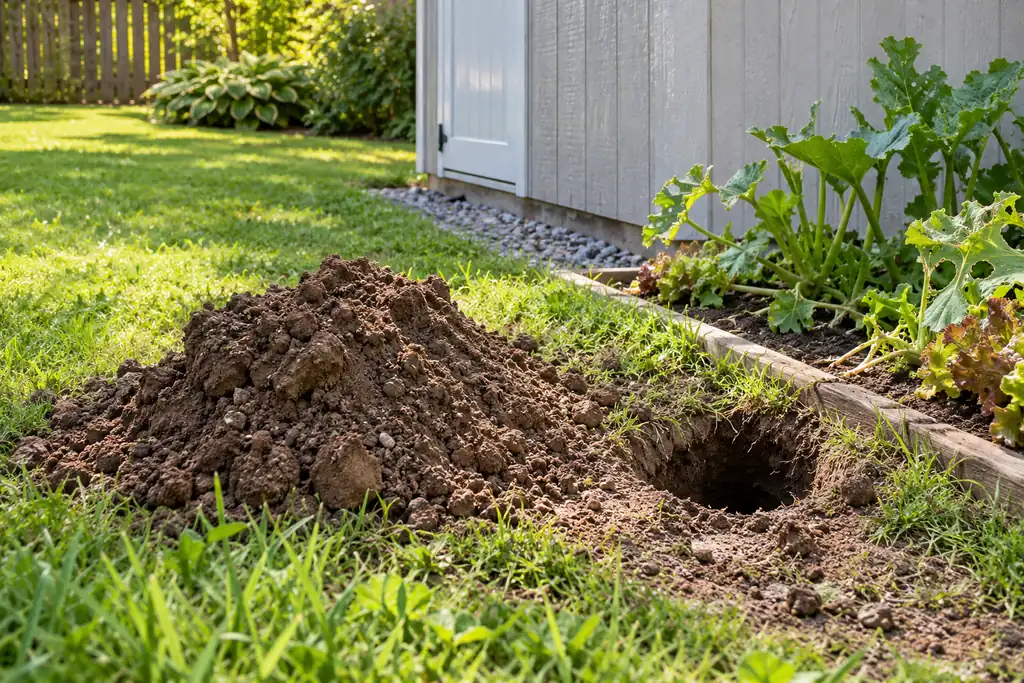
Signs of a groundhog burrow
You'll see them in daylight, since that's when it's out.
- A wide, round hole under the shed, porch or along the foundation, with a pile of fresh dirt in front
- One or more other, less obvious openings a few metres away, sometimes hidden in a hedge or flower bed
- A trail of flattened grass between the burrow and the garden
- Vegetables and flowers eaten down to the ground in broad daylight
- A groundhog spotted early in the morning or late in the day, sitting near the hole and diving in at the slightest noise
- Pavers, steps or a slab sinking near a hole
How we empty and seal a groundhog burrow
A burrow has several doors, so we find them all before we start.
Locating the entrances
We go over the yard, hedges and structures to find every entrance, active or not, and note where each one sits in relation to the shed, porch and foundation.
Trapping at the active entrance
Cages sized for groundhogs are set by the entrance it's using, timed around its outings. From spring to the end of summer, no entrance gets sealed until we've checked for young.
Removal, then the empty burrow
The trapped groundhog is removed as Quebec rules provide. Meanwhile, the empty burrow is an open invitation: if nobody closes it, another groundhog can move in.
Sealing the burrow
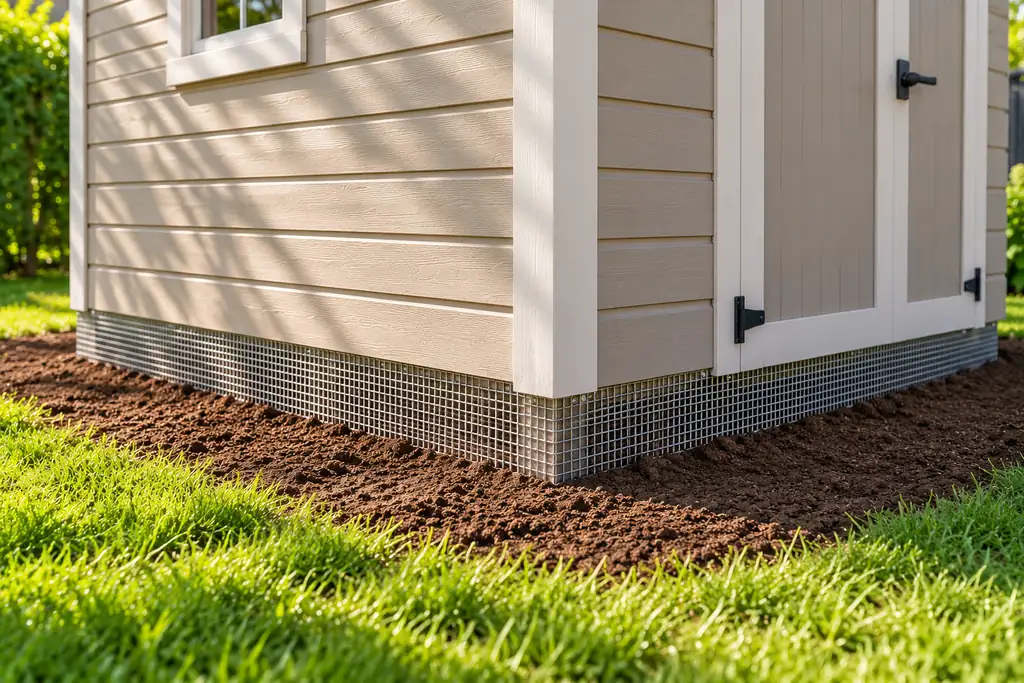
With the burrow empty, every entrance is sealed, and the base of the shed or porch can be ringed with mesh whose bottom edge is buried and bent outward. The steps are detailed under sealing entry points.
So no other groundhog takes over the burrow
- Have every burrow entrance sealed once the groundhog is gone: an open burrow draws the next one.
- Fence the vegetable garden with metal mesh about a metre high, buried at least twenty-five to thirty centimetres, ideally forty-five to sixty.
- When you put in a new shed, plan buried mesh around its base instead of leaving an open gap underneath.
- Pick up fallen fruit and vegetables, and don't pile branches or wood against the shed, where they hide an entrance.
- Walk the yard when hibernation ends, in late winter: a new hole caught early is simpler to deal with.
 Service 24/7, free quote
Where we find groundhog burrows

Residential
- Under sheds and storage buildings
- Low porches and patios
- Along foundations and window wells
- Slopes, rock gardens and hedges
- Vegetable gardens and flower beds
Commercial and industrial
- Grassy slopes around parking lots
- Industrial sites with large green spaces
- Rail corridors and vacant lots
- Slab-on-grade buildings surrounded by lawn
- Lawns around schools and institutions
Frequently asked questions
Can't find what you're looking for? A technician answers 24/7.
Call 514-231-1615How can I tell if the burrow under my shed is still active?
In the evening, loosely plug the entrance with a little loose soil or crumpled newspaper, without packing it in. If it's cleared by the next day, the burrow is in use. Also look for fresh dirt at the hole and nibbled plants in the garden, and between April and August, check that the burrow holds no young before sealing anything.
Can a groundhog damage my house's foundation?
It won't dig through concrete, but its tunnels can leave voids along a wall, under a slab or under steps. If the ground sinks or a slab shifts near the burrow, have a contractor look at it once the animal is gone. On our end, we seal the entrances to cut off its way back.
When do groundhogs come out of hibernation?
Usually around February or March, at the end of winter or in early spring. They go back into the burrow in the fall to hibernate, so in winter a burrow that looks abandoned may have a groundhog sleeping inside. That's no time to block it without checking.
Is filling the hole with dirt enough?
No, not while the groundhog is inside or other entrances are still open: a burrow has two to five, linked by tunnels, and it will reopen the hole or dig a new one. It has to be gone first, then every entrance gets sealed. If what you're seeing is small holes near the foundation or the bins, also consider rats in the yard.
How much does groundhog removal cost?
It depends on how many entrances the burrow has, where it is (shed, porch, foundation), whether there are young and how much of the structure needs protecting. Quotes are free, after a look at the yard.
